
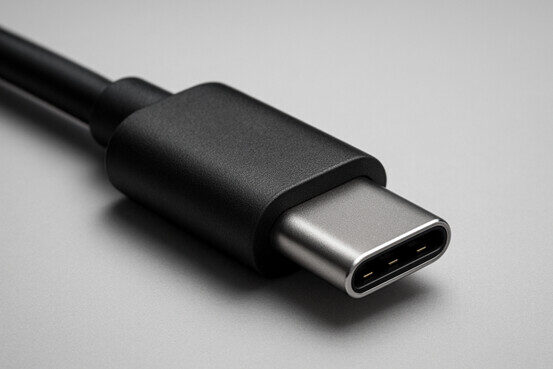
USB Type-C has become the standard interface across modern electronic devices—from smartphones and laptops to automotive systems, medical equipment, and industrial controllers.
It is more than just a reversible connector shape; it is a comprehensive interface and communication standard that supports high-speed data transfer, high-power charging, and the integration of video and data signals. Its introduction has simplified product design and accelerated the unification and interoperability among different electronic devices.
Key Features of USB Type-C
- Reversible Design
The Type-C connector features a symmetrical design, allowing it to be plugged in either way, improving user convenience and durability. - High-Speed Data and High-Power Delivery
USB Type-C supports the USB 3.2, USB4, and even Thunderbolt 4 standards, enabling data transfer rates of up to 40 Gbps. Through the USB Power Delivery (PD) protocol, it can deliver up to 240W of power, allowing a single cable to handle both power and data transmission efficiently.\ - Multi-Function Integration
Beyond power and data transmission, Type-C can carry DisplayPort Alt Mode or HDMI Alt Mode signals, enabling laptops or tablets to connect directly to external displays, projectors, or cameras.
The table below summarizes the applications and key functions of USB Type-C in different domains.
| Application Domain | Example Applications | Key Functions |
| Smartphones, Laptops | Charging and data transfer, single-port laptop charging, docking stations, external displays | High-power charging (PD), high-speed data transfer, video output (DP Alt Mode) |
| Automotive (Automotive-Grade) | Infotainment systems, in-car charging ports, digital dashboards | High reliability, power and data integration, compliance with AEC-Q100 automotive standards |
| Medical and Industrial Equipment | Medical imaging systems, industrial PCs (IPC), human-machine interfaces (HMI) | High stability and reliability, minimizing risk of system failure |
| Others | Monitors, external drives, printers, game consoles, cordless vacuum cleaners, and power tools | Single-cable solution for all charging and data needs, becoming a universal connectivity standard |
Importance of Type-C in Automotive and Industrial Applications
In automotive, medical, and industrial environments, components must remain stable under high temperature, vibration, and long-term operation. For this reason, Type-C interfaces used in automotive-grade products must comply with rigorous standards such as AEC-Q100 or IATF 16949 to ensure reliability and safety.
For example, an in-car Type-C charging port may look ordinary, but it must withstand frequent plug-in cycles, high cabin temperatures, and voltage fluctuations—all while maintaining stable data communication with the vehicle system. These requirements rely on robust electronic design and thorough testing validation.
How iSTART-TEK Supports Type-C Related IC Testing
USB Type-C–related ICs, such as power management ICs, interface bridge ICs, and signal switch ICs, must undergo stringent electrical and reliability testing.
iSTART-TEK provides comprehensive MBIST, eFlash BIST, and automotive-grade test solutions for high-speed interface and power management ICs, helping customers ensure consistent performance under high-speed transmission and high-power operating conditions.
Extended Reading: How MBIST and MBISR Safeguard USB Type-C Controller Chips